
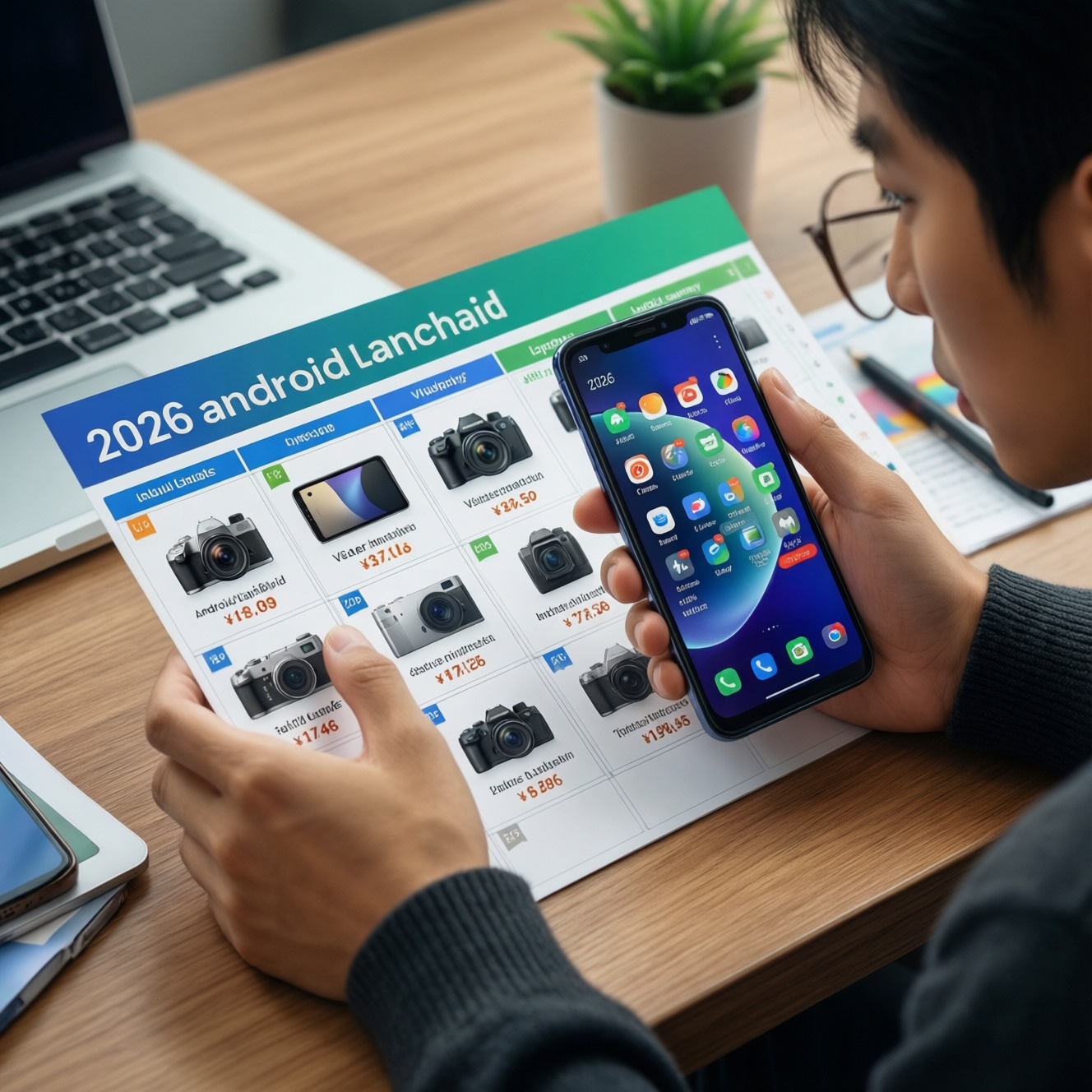
If you're planning purchases around a ตารางเปิดตัวมือถือ Android 2026, treat it as a timing tool, not a promise: Android launches cluster into a few predictable windows, and the best "wait vs buy now" choice depends on your priorities (camera, battery, updates, price). Use the calendar below to shortlist models, then decide using the decision tree.
Release snapshot: what matters this year
- Most launches follow repeatable "waves" (early-year flagships, mid-year foldables, late-year refreshes), but exact dates move.
- Camera upgrades are increasingly about consistency (main + telephoto + processing), not just megapixels.
- Battery gains often come from efficiency and newer cell chemistry rather than bigger size.
- Update policy matters as much as hardware; check OS upgrades and security patch cadence before preordering.
- Price drops on last-gen flagships can be the best value window if you don't need the newest chipset.
Month-by-month Android launch calendar (by OEM)
Use this section as a planning template for มือถือ Android รุ่นใหม่ 2026 เปิดตัวเมื่อไหร่. Exact dates depend on each brand's regional strategy (global vs Thailand-first rollouts) and supply. Before you decide to wait, evaluate these criteria.
Criteria to choose what to wait for (and what to buy now)
- Camera priority: main sensor quality, telephoto presence, stabilization, and processing style.
- Battery priority: endurance vs charging speed vs heat management under load.
- Performance profile: sustained performance (thermals) vs peak benchmarks.
- Display: LTPO/refresh behavior, brightness consistency outdoors, PWM sensitivity.
- Updates: OS upgrade count, security patch frequency, and how fast updates arrive in Thailand.
- Connectivity: eSIM availability, Wi‑Fi generation, and local band support.
- Durability: ingress rating, frame rigidity, screen protection, repairability and parts availability.
- Ecosystem fit: tablets/watches/earbuds integration, PC link features, and backup/restore tools.
Planning calendar (typical windows by OEM)

| Window (month range) | OEMs most active | What usually launches | What to watch in spec sheets |
|---|---|---|---|
| Jan-Mar | Samsung, Xiaomi, OnePlus, vivo | Mainstream "flagship slab" lines and early-year refreshes | New flagship SoC, camera ISP changes, improved thermals, longer update promises |
| Apr-Jun | OPPO, realme, POCO, HONOR | Upper-midrange and performance-value models | Cooling design, sustained FPS, charging curves, camera trade-offs (telephoto often missing) |
| Jul-Sep | Samsung, Google, vivo, OPPO | Foldables and camera-focused flagships; some "Pro/Ultra" cycles | Hinge durability, crease visibility, camera compromises on foldables, AI features that work offline |
| Oct-Dec | Xiaomi, OnePlus, iQOO, ASUS (select markets) | Late-year flagship refreshes and gaming-oriented releases | Next-gen SoC availability, early Android version adoption, accessory ecosystem |
When people ask มือถือ Android รุ่นใหม่ 2026 มีรุ่นไหนบ้าง, the practical answer is: expect the usual flagship families (Galaxy S/Flip/Fold, Pixel, Xiaomi flagship line, OnePlus flagship line) plus aggressive midrange series from OPPO/realme/vivo/Redmi. The sections below compare them by buyer fit and timing.
Flagship rollouts: expected specs, priority features, and timing

Flagships are where timing matters most: early buyers pay the most but get the longest runway of updates; late buyers get better deals and more reviews. The options below are "families" you can track in Thailand, not guaranteed single model names.
| Option | Who it fits | Pros | Cons | When to pick it |
|---|---|---|---|---|
| Galaxy S-class (base/plus/ultra tier) | Balanced flagship buyers who want dependable cameras, wide service coverage, and fast regional availability | Strong all-rounder cameras; mature ecosystem; typically clear update policy; good accessory availability in TH | Value drops faster after launch; "Ultra" tiers can be bulky; charging speed not always class-leading | Choose when you want predictable resale, support, and minimal risk buying early |
| Galaxy Z Fold/Flip class | Multitaskers, creators, and people who want pocketability (Flip) or tablet-like workflow (Fold) | Unique form factor; productivity features; strong trade-in programs (where available) | Cameras can be a tier behind top slabs; durability anxiety; repairs are costlier | Choose when form factor is the priority and you can accept camera/value trade-offs |
| Pixel flagship line | People who prioritize clean software, fast Android version updates, and computational photography style | Consistent photo processing; early Android features; strong voice/call screening-type tools (feature availability varies) | Thailand availability and service options can be more limited depending on channel; gaming thermals vary by generation | Choose when updates and camera "look" matter more than raw charging speed or widest retail availability |
| Xiaomi flagship line (incl. camera-collab tiers) | Spec-focused buyers who want top hardware and fast charging, often with aggressive launch promos | Very competitive display and charging; strong main camera hardware on top tiers | Software experience varies by region/build; preinstalled apps can be a turn-off; camera consistency across lenses varies | Choose when you want maximum hardware per baht and are okay tuning settings and updates |
| OnePlus flagship line | People who want smooth performance, fast charging, and a "fast-feeling" UI | Strong performance-per-cost; responsive UI; charging convenience | Camera can be less consistent than camera-first flagships depending on model; local promos/stock fluctuate | Choose when performance + charging outrank zoom camera needs |
| vivo X / OPPO Find camera-first flagships | Portrait, low-light, and zoom-focused users who care about color science and stabilization | Often excellent portrait processing; strong telephoto/zoom focus on higher tiers | Top variants may be limited by region; pricing can be high without promos | Choose when you want the safest bet for people/portrait shots and stabilized video |
Midrange and budget launches: value propositions and best windows to buy
Midrange is where you can "win" on value, but only if you match the phone to the job. Use these scenarios to decide whether waiting makes sense.
- If you mainly want battery and reliability, then wait for the next midrange refresh that upgrades efficiency and thermals; buy once long-term reviews confirm standby drain is stable.
- If you game on a budget, then choose performance-focused sub-brands/models when they launch, but only after you verify sustained performance (cooling) rather than headline chipset names.
- If camera matters but you can't pay flagship prices, then target upper-midrange models that add OIS and better processing; skip models that rely on "macro/depth filler" cameras.
- If you need the best price, then buy last-gen upper-midrange right after the new generation is announced-this is often the cleanest discount window without sacrificing daily speed.
- If updates are your priority in midrange, then favor brands/series with a clear OS + security pledge and a track record of timely Thailand rollouts.
For people searching มือถือ Android 2026 รุ่นไหนน่าซื้อ in the midrange, the most defensible approach is to shortlist by update policy and thermals first, then compare cameras and charging second. Midrange "spec wins" often hide long-term compromises like aggressive background-kill or unstable battery drain.
OS and update roadmap: Android versions, beta schedules, and support promises
Don't pick a model purely on launch timing. Use this fast checklist to decide which release wave to target for the Android version you want and the support you'll actually receive.
- Write down the minimum support you need: number of major Android upgrades and security patch cadence.
- Check whether the model family typically ships with the current Android version at launch or arrives one version behind.
- Confirm the brand's Thailand firmware track record: do updates arrive quickly, and do carrier/retail channels differ?
- Prefer models with clear policy wording (OS upgrades + years of security) over vague "extended support" marketing.
- If you like early features, verify whether beta programs are available to your region/device variant and whether banking apps remain stable on beta.
- Before preordering, scan early reports for update stability: modem issues, battery drain after patches, camera regressions.
- Choose the release wave that aligns with your patience: launch-day ownership vs post-update maturity after a few patches.
Decision tree: which upcoming model should you wait for
If your question is ควรรอมือถือรุ่นใหม่ 2026 รุ่นไหนดี, the biggest mistakes come from waiting for the wrong "next thing" or optimizing one spec while ignoring the cost. Avoid these common decision errors.
- Waiting for a rumored feature without defining what problem it solves (photos, battery, updates, gaming, work).
- Assuming a newer chipset automatically means better battery; software tuning and modem behavior matter.
- Buying a foldable expecting slab-flagship cameras; many foldables trade camera modules for space.
- Overpaying at launch without valuing early ownership (work needs, travel, broken phone replacement).
- Ignoring after-sales realities in Thailand (warranty handling, parts lead time, authorized repair availability).
- Chasing the fastest charging while ignoring heat and battery aging behavior.
- Picking by "RAM/storage" alone and missing the real bottleneck (thermal throttling, slow storage tier, weak modem).
- Assuming all Android update promises are equal; timing and region rollout can be as important as duration.
Comparative launch table: price, specs, and recommended buyer actions
- Start: What is your #1 priority?
- Camera consistency (people + low light + zoom) → wait for camera-first flagships (vivo X / OPPO Find tiers) or a Galaxy S Ultra-tier; buy after early camera reviews confirm telephoto quality.
- Longest, simplest update path → prioritize Pixel flagship line or Galaxy S-class; buy closer to launch to maximize support runway.
- Best value per baht → target last-gen flagships after the next wave is announced; choose once prices normalize and stock is stable in TH.
- Gaming + charging convenience → look at OnePlus-style performance flagships or gaming-leaning late-year launches; buy only after sustained performance tests are out.
- Multitasking portability → choose Fold/Flip class; buy if you accept camera/value trade-offs and have access to reliable repair channels.
| Model family (track this year) | Likely price posture in TH | Spec focus to compare | Recommended buyer action |
|---|---|---|---|
| Galaxy S-class | Premium | Camera balance, display, update policy, service availability | Buy near launch if you want the longest support runway; otherwise wait for first major promo cycle |
| Galaxy Z Fold/Flip class | Premium+ | Hinge, crease, durability, multitasking features, camera compromises | Wait for durability and repair-cost clarity; buy only if form factor is your top priority |
| Pixel flagship line | Premium (channel-dependent) | Update speed, camera processing style, modem stability, local warranty channel | Buy if you prioritize software/updates; avoid if you need the broadest retail support unless your channel is solid |
| Xiaomi flagship line | Premium with promo swings | Charging, display, main camera hardware, software experience | Consider at launch promos, but verify software fit and bloat tolerance; buy after initial firmware patches if cautious |
| OnePlus flagship line | Upper-premium | Sustained performance, charging, UI responsiveness, camera consistency | Buy if performance/charging lead; wait for camera comparisons if zoom/portraits matter |
| vivo X / OPPO Find camera-first flagships | Premium, often tiered | Portrait, telephoto stabilization, video stabilization, skin tones | Wait for real camera samples; buy when you see consistent results across main + tele lenses |
Best fit tends to be: updates and low-risk ownership (Galaxy S-class or Pixel line), camera-first portraits/zoom (vivo X / OPPO Find tiers), charging + hardware value (Xiaomi/OnePlus-style flagships), and multitasking form factor (Fold/Flip)-pick the lane that matches your daily use, then time your purchase around promos or post-launch firmware maturity.
Quick clarifications on launches, preorders, and trade-offs
Is a launch calendar a guarantee of release dates in Thailand?
No. Use it as a planning guide; Thailand availability can lag global announcements depending on certification, stock, and channel strategy.
Should I preorder a flagship or wait for reviews?
Preorder if you value early ownership and trusted support. Wait if camera consistency, modem stability, or battery drain is critical-those are clearer after real-world tests.
Do foldables now match slab flagships for cameras?
Sometimes, but many foldables still trade camera hardware for thinness and hinge space. Compare telephoto and video stabilization carefully.
Will the newest Android version automatically mean better performance?
Not automatically. Performance often depends on chipset thermals, modem firmware, and OEM tuning as much as the Android version number.
When is the best time to buy last year's flagship?
Right after the next generation is announced and retail pricing stabilizes. That window often brings meaningful discounts without losing day-to-day speed.
How do I prioritize battery vs fast charging?
Decide which failure hurts more: running out mid-day (endurance) or slow top-ups (charging). Then check real reviews for heat and sustained behavior, not just wattage claims.