
If you're deciding between a newer GPU and a previous generation, prioritize the option that meets your target resolution (1440p/4K), stays within your PSU/thermal limits, and delivers the lowest real cost per delivered frame in your games. This page shows how to compare real frame-rate behavior, sustained power draw, and price-value trade-offs in Thailand.
Quick practical summary for buyers
- For "การ์ดจอรุ่นใหม่ vs รุ่นก่อน เฟรมเรตจริง", compare average FPS and 1% lows in your own game mix at 1440p first, then validate at 4K if you use it.
- Power and heat matter: "รีวิวการ์ดจอ กินไฟเท่าไหร่" should include sustained gaming load, not just short benchmarks.
- A previous-gen higher tier can beat a newer lower tier, but may cost more in electricity, noise, and case/PSU upgrades.
- Value is total cost: GPU price + PSU/cooling changes + time spent troubleshooting drivers/BIOS + resale risk (especially used).
- For "แนะนำการ์ดจอเล่นเกม 1080p 1440p รุ่นใหม่", a current-gen midrange is the safest "set and forget" choice for most intermediate players.
- If you ask "การ์ดจอคุ้มค่าต่อราคา รุ่นไหนดี", the answer usually depends on local promo pricing and whether you can avoid PSU/case changes.
Real-world frame-rate comparisons (1440p & 4K)
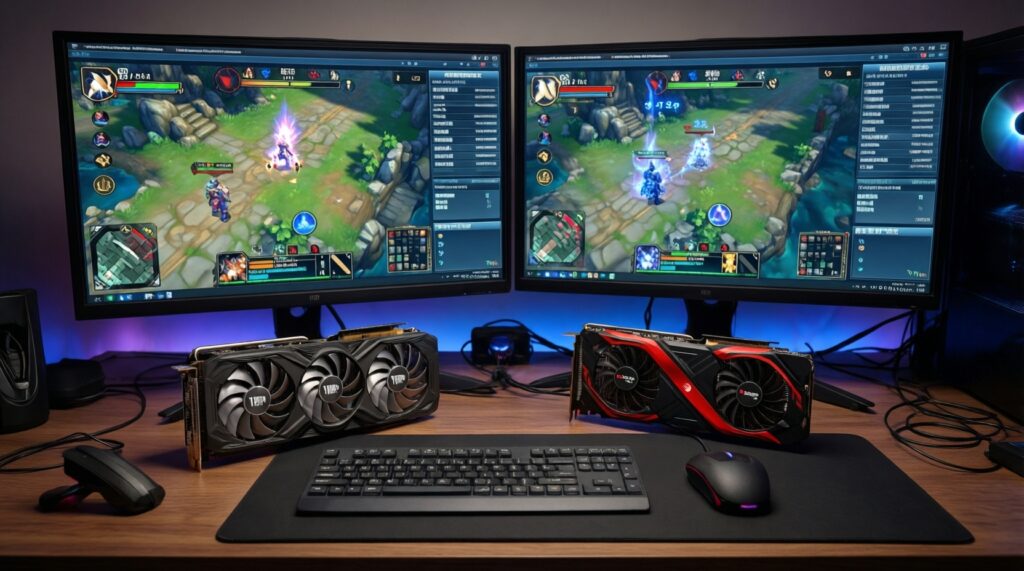
Use these criteria when you do a real comparison (เปรียบเทียบการ์ดจอรุ่นใหม่กับรุ่นเก่า) rather than relying on a single benchmark chart:
- Game mix relevance: test the titles you actually play (competitive shooters vs open-world vs sim).
- Resolution and settings lock: 1440p "High" with the same upscaling/RT settings across cards; then repeat at 4K if needed.
- 1% lows and frame pacing: smoothness matters as much as the average FPS.
- VRAM headroom: watch for stutter or texture drops at 1440p/4K when VRAM is near full.
- CPU bottlenecks: a fast GPU can look "equal" at 1440p if your CPU caps performance; confirm with a heavier scene or higher resolution.
- Thermal steady state: compare after 10-20 minutes, not only the first minute.
- Upscaling/frame generation usage: compare native vs upscaled separately; don't mix them in one "winner" conclusion.
- Driver version parity: run current stable drivers for both generations where possible.
Power draw and thermal behavior under sustained load
This comparison focuses on what you feel in day-to-day gaming: PSU stress, case heat, fan noise, and sustained clocks. Because local pricing and models vary, the table uses practical, non-numeric tiers (e.g., "High/Medium/Low") you can map to specific cards sold in Thailand.
| Option | Who it fits | Pros | Cons | When to choose |
|---|---|---|---|---|
| Current-gen entry-level (new) | 1080p players, small PSUs, compact cases |
|
|
Pick if you mainly want efficient 1080p today and don't want PSU/case upgrades. |
| Current-gen midrange (new) | Mainstream 1440p gaming, balanced builds |
|
|
Default recommendation for "แนะนำการ์ดจอเล่นเกม 1080p 1440p รุ่นใหม่" if you want smooth 1440p without drama. |
| Current-gen enthusiast (new) | 4K gaming, RT-heavy titles, high-refresh 1440p |
|
|
Choose if you truly play at 4K or use RT often and can support it with PSU/cooling. |
| Previous-gen midrange (used) | Budget-focused buyers comfortable with used risk |
|
|
Pick when the discount is large enough to offset efficiency and risk, and you can test before buying. |
| Previous-gen high-end (used) | People chasing high FPS per baht without buying new |
|
|
Choose if you're comfortable optimizing undervolt/fan curves and your PSU/case can handle it. |
| Wait/temporary solution (keep current GPU or use iGPU) | Upgraders between price cycles, light gaming, esports only |
|
|
Choose if current Thailand pricing makes "การ์ดจอคุ้มค่าต่อราคา รุ่นไหนดี" hard to justify today. |
Performance-per-watt and efficiency trade-offs
- If your PSU is borderline or your case airflow is limited, then prefer a current-gen tier that hits your target FPS at lower power (often midrange new) instead of a used previous-gen high-end.
- If you game for long sessions in a warm room, then prioritize efficiency and cooler quality; sustained clocks and noise will matter more than peak benchmark spikes.
- If you pay extra for a higher tier but play mostly CPU-limited esports at 1080p/1440p, then you're buying watts and heat you won't convert into real FPS.
- If you plan to use upscaling/frame generation routinely, then compare "effective FPS" with the same settings; the more efficient card typically needs less fan noise to maintain that experience.
- If you're comparing "การ์ดจอรุ่นใหม่ vs รุ่นก่อน เฟรมเรตจริง" across brands, then check whether one option needs undervolting to be comfortable; "needs tuning" is a cost.
Price-to-performance: cost per frame and total cost of ownership
- Define your target: 1440p high-refresh, 4K, or mixed; list 5-10 games you actually play.
- Shortlist 2-3 tiers (not just one model): current-gen midrange, current-gen enthusiast, previous-gen high-end used.
- Estimate hidden costs: PSU upgrade, extra case fans, GPU support bracket, adapter cables, and time for troubleshooting.
- Check local warranty reality (shop warranty vs manufacturer vs none for used) and factor the hassle cost.
- Compare "real delivered frames" by checking both average FPS and 1% lows at 1440p and 4K settings you will use.
- Decide your value target: lowest total cost for acceptable FPS (budget) vs best experience (noise/thermals/stability) per baht.
- Buy only if the chosen tier clearly improves your bottleneck; otherwise wait for a better promo cycle in Thailand.
Driver maturity, feature set and platform compatibility
- Mixing benchmark results from different driver versions, then concluding "new vs old" performance without parity.
- Ignoring PSU transient behavior and connector compatibility; a "works on paper" PSU can still cause crashes under spikes.
- Buying by average FPS only and missing poor 1% lows (stutter) that make "เฟรมเรตจริง" feel worse.
- Assuming your case fits: length, thickness, and power-cable bend clearance often block installation.
- Overlooking monitor needs (VRR type, HDMI/DP version) and ending up limited by port capability.
- Comparing upscaling/frame generation on one card to native rendering on another, then calling it equal value.
- Underestimating heat soak in Thai ambient conditions; sustained performance may drop if airflow is weak.
- Buying used without verifying fan condition, paste condition, coil whine tolerance, and prior heavy use.
- Forgetting CPU/RAM balance; an underpowered CPU can waste money on a higher tier GPU.
Upgrade decision tree by use case and budget
Use this quick tree to decide before you shop (it's the fastest way to answer "การ์ดจอคุ้มค่าต่อราคา รุ่นไหนดี" for your own build).
Entry budget path
- If you play mostly 1080p and want low heat/noise, choose Current-gen entry-level (new).
- If you can buy used safely and the discount is substantial, choose Previous-gen midrange (used).
- If pricing is poor this month, choose Wait/temporary solution.
Mainstream budget path
- If your target is stable 1440p and you want minimal tuning, choose Current-gen midrange (new).
- If you can handle more heat/power and a PSU check, and used pricing is very attractive, choose Previous-gen high-end (used).
Enthusiast budget path
- If you play 4K or RT-heavy titles and have strong PSU/cooling, choose Current-gen enthusiast (new).
- If you're mainly competitive at 1440p and already CPU-limited, choose Current-gen midrange (new) and invest the difference in CPU/platform.
Best fit for most 1440p buyers in Thailand is typically a current-gen midrange (new) because it balances "การ์ดจอรุ่นใหม่ vs รุ่นก่อน เฟรมเรตจริง" with manageable power and fewer used-market risks. Best fit for pure value hunters who can test hardware is often a previous-gen high-end (used), as long as PSU, heat, and warranty trade-offs are acceptable.
Answers to common upgrade doubts
Can a previous-gen high-end beat a new midrange in real games?
Yes in many titles, especially at 1440p, but it often does so with higher power draw, heat, and potential used-condition risks.
How should I interpret "รีวิวการ์ดจอ กินไฟเท่าไหร่" for my PC?
Look for sustained gaming load behavior and PSU connector requirements, not only short peaks. Also consider case airflow because heat affects clocks and noise.
Is 4K the right reason to upgrade today?
Upgrade for 4K if you're willing to use upscaling settings consistently or you're buying an enthusiast-tier card. Otherwise, 1440p usually delivers better value and stability.
Is buying used worth it in Thailand?
It can be if you can test the card, confirm remaining warranty (if any), and accept the risk of prior heavy use. If you need reliability with minimal hassle, buy new.
What matters more: average FPS or 1% lows?
For perceived smoothness, 1% lows and frame pacing often matter more than a slightly higher average FPS.
Do I need to upgrade my PSU when moving to a higher tier?
Sometimes. If the new GPU tier is known for higher sustained draw or spikes, ensure adequate PSU headroom and correct connectors before purchase.
Which is the simplest "แนะนำการ์ดจอเล่นเกม 1080p 1440p รุ่นใหม่" pick?
A current-gen midrange card is usually the simplest choice for 1440p because it balances performance, efficiency, and driver support without requiring heavy tuning.