
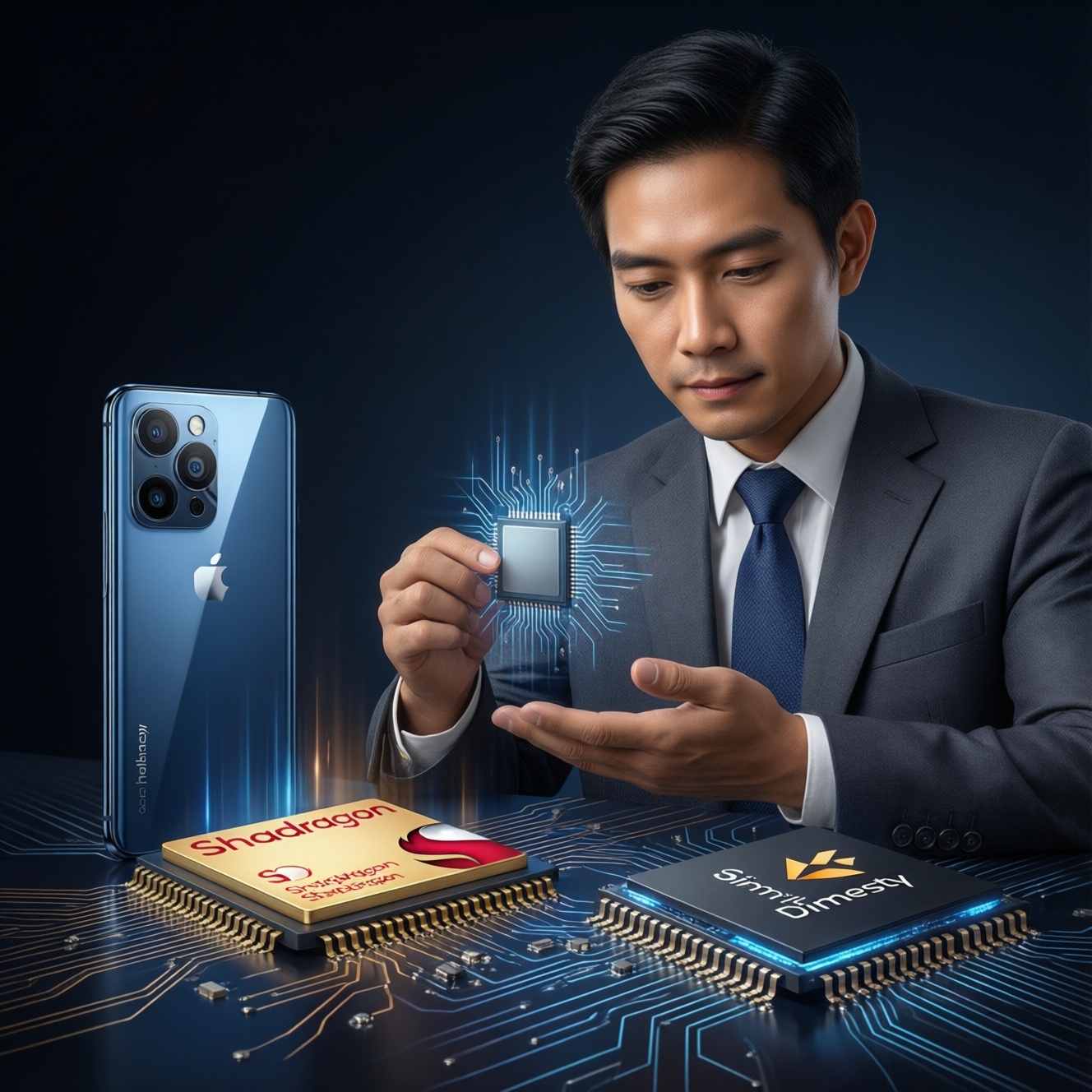
To pick the best new mobile chipset, start with your ecosystem and sustained performance needs: A-series typically wins on tightly integrated iOS efficiency and predictable camera pipelines, Snapdragon leads for broad Android compatibility and premium features, and Dimensity often delivers strong value with competitive AI and connectivity. For Thailand in 2026, the best choice depends more on your usage persona than on peak scores.
Executive summary of chipset performance and suitability
- A-series is the safest bet for consistent day-to-day speed, long-term iOS optimization, and dependable camera processing in iPhone models.
- Snapdragon flagships are the most flexible Android baseline for gaming tuning, accessory support, and app compatibility across brands.
- Dimensity flagships can be an efficient Android alternative; the best ones feel close to Snapdragon in real use, often in aggressively priced devices.
- Near-flagship chips (Snapdragon upper-tier, Dimensity upper-tier, older A-series) can outperform "newer" midrange chips in sustained workloads.
- Thermals and OEM tuning matter: the same chip can feel different across phone models due to cooling, power limits, and software.
- Choose with sustained performance, ISP/camera needs, and modem features first; use synthetic benchmarks only as a tie-breaker.
Architectural differences: CPU, GPU and NPU approaches
Use these criteria to make a clean comparison (including when you're doing เปรียบเทียบชิป A-series กับ Snapdragon รุ่นล่าสุด or checking ชิป Dimensity รุ่นล่าสุด ดีไหม เทียบ Snapdragon):
- CPU scheduling behavior: responsiveness under mixed loads (messaging + maps + camera) matters more than brief peak speed.
- Sustained CPU performance: stability over long sessions (gaming, navigation, video export) depends on power limits and cooling, not just cores.
- GPU sustained load: frame-rate stability and thermal throttling matter more than short benchmark bursts.
- NPU/AI throughput vs on-device latency: real benefit shows in offline transcription, photo classification, live captions, and generative features.
- ISP and camera pipeline: HDR consistency, motion handling, skin-tone stability, and video stabilization are often chipset-pipeline dependent.
- Memory subsystem: how well the chip feeds CPU/GPU/NPU affects multitasking, camera burst capture, and high-res video.
- Codec support: decode/encode capabilities influence battery life and heat during streaming, recording, and editing.
- Modem + RF design tolerance: real network experience in Thailand depends on modem generation plus the phone's antenna design.
- Vendor software stack maturity: drivers, game optimizations, and OS update cadence can outweigh a small hardware edge.
Process nodes, power efficiency and thermal behavior

Interpret process node claims as "efficiency potential," not a guarantee. Final battery life and heat depend on the phone's cooling, screen efficiency, modem use, and OEM power policy. If your goal is ชิปมือถือรุ่นล่าสุด 2026 แนะนำ รุ่นไหนดีที่สุด, prioritize sustained performance and thermals over peak bursts.
| Variant | Who it fits | Pros | Cons | When to choose |
|---|---|---|---|---|
| A-series (latest flagship iPhone tier) | iOS-first users, long update horizon, consistent camera/video | Strong end-to-end efficiency; predictable performance; tight OS + app optimization | Limited device choice; fewer "tweakable" gaming controls than many Android flagships | When you want maximum consistency and minimal tuning effort |
| A-series (previous-gen / near-flagship iPhone tier) | Value-focused iOS buyers | Excellent real-world speed; often strong sustained behavior due to mature tuning | Fewer newest on-device AI features depending on model generation | When "good enough flagship feel" matters more than owning the newest silicon |
| Snapdragon 8-series (latest flagship) | Android power users, mobile gamers, accessory-heavy workflows | Broad Android ecosystem; strong GPU feature set; common target for game optimization | Performance varies widely by phone cooling; can draw more power under heavy GPU load | When you want the most predictable compatibility across Android apps and devices |
| Snapdragon upper-tier (near-flagship) | Balanced buyers who want cooler operation than some flagships | Often better value; can sustain longer with simpler thermal budgets | Less headroom for top-end camera/video features; varies by OEM | When you want high-end feel without flagship heat and price |
| Dimensity flagship tier (latest) | Android buyers optimizing value, efficiency, and modern connectivity | Competitive efficiency potential; strong AI blocks in many implementations | Game-specific optimizations can be less consistent on some titles/engines | When the device offers strong cooling and you're getting better specs per baht |
| Dimensity upper-tier (near-flagship) | Everyday heavy users on a budget | Good performance-per-watt; often excellent battery life in well-tuned phones | Flagship camera pipelines and "pro" video features may be more limited | When you prioritize battery and smoothness over absolute top-end FPS |
Qualitative spec alignment (useful when shopping Thai listings)
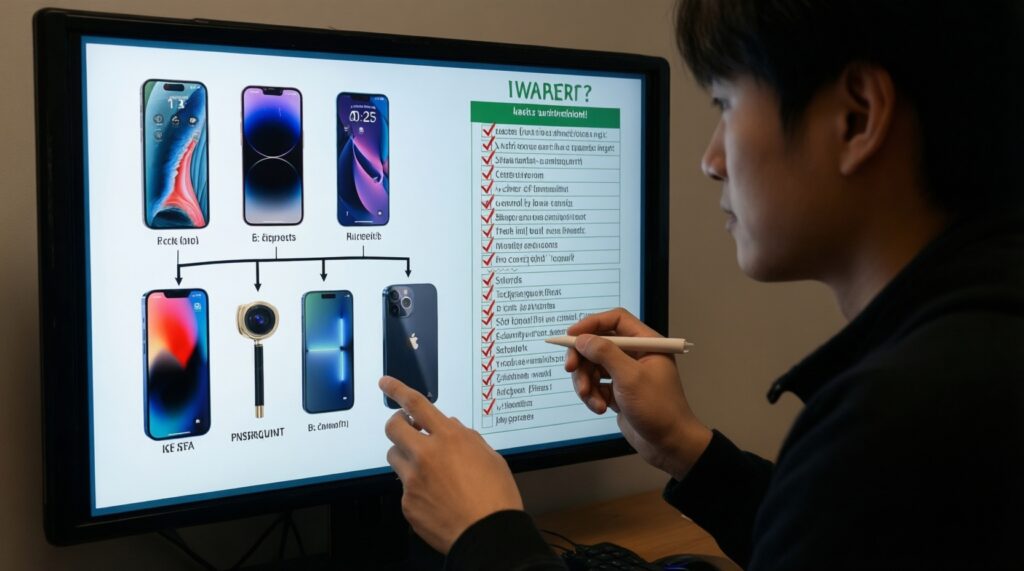
When you see มือถือชิป A-series รุ่นล่าสุด ราคา และสเปก pages or Android spec sheets, use this table as a "what to ask next" checklist, not as a literal datasheet.
| Family | CPU cores | GPU | NPU / AI engine | Node | Peak perf | Sustained perf | Power draw |
|---|---|---|---|---|---|---|---|
| A-series (flagship) | Hybrid multi-core (varies by generation) | Integrated GPU tuned for iOS workloads | On-device AI tightly integrated with OS features | Leading-edge node (varies) | Very high | High and consistent | Controlled by aggressive system-level management |
| Snapdragon (flagship) | Hybrid multi-core (varies by SKU) | High-feature GPU with broad engine support | Strong AI acceleration with vendor tooling | Leading-edge node (varies) | Very high | Ranges from high to variable (device-dependent) | Can rise quickly under sustained GPU loads |
| Dimensity (flagship) | Hybrid multi-core (varies by SKU) | Competitive integrated GPU (implementation-dependent) | Often strong AI blocks for camera and on-device tasks | Leading-edge node (varies) | High to very high | High when cooling is solid | Often efficient; depends on modem usage and OEM tuning |
Real-world benchmarks: synthetic scores vs sustained performance
Synthetic numbers help identify a tier, but they do not predict heat behavior, camera consistency, or network battery drain. Use scenario rules:
- If you play long gaming sessions on cellular data, then prioritize sustained GPU stability and modem efficiency; a well-cooled Snapdragon flagship or a well-tuned Dimensity flagship is usually the safer Android bet.
- If you shoot lots of short videos for social media, then prioritize ISP consistency and fast background processing; A-series devices typically feel the most predictable end-to-end.
- If you do navigation + camera + messaging simultaneously (delivery/field work), then prioritize thermal stability and screen-on battery; near-flagship Snapdragon/Dimensity models can be better than thin flagships.
- If you edit photos/video on-device, then prioritize sustained CPU plus hardware codecs; choose the device with proven export stability rather than the highest peak score.
- If you care about emulation and game compatibility, then prioritize Snapdragon ecosystem support and driver maturity; this is often what people mean by ชิป Snapdragon รุ่นล่าสุด แรงสุด รุ่นไหน in practical terms.
Connectivity, multimedia and AI feature comparisons
- Start with network reality in Thailand: check your main carrier bands and your usage (hotspot, dual SIM, travel). Prioritize the phone's modem generation plus antenna design.
- Confirm codec needs: if you record or edit, verify hardware encode/decode support in the phone's spec sheet (not just the chipset family name).
- Decide on on-device AI scope: offline transcription, live captions, image cleanup, and generative features benefit from stronger NPU and vendor frameworks.
- Validate camera pipeline features: look for stable HDR video, reliable night mode processing, and consistent skin tones across lenses.
- Check gaming frame stability: search for long-session tests on the exact phone model, not just the chip; cooling design dominates.
- Match ports and peripherals: display-out, controllers, external storage, and car integrations can push you toward Snapdragon (Android flexibility) or A-series (ecosystem consistency).
Ecosystem impact: software optimization and developer support

- Buying by chipset name only: the same Snapdragon/Dimensity tier can behave very differently across brands due to cooling and power limits.
- Confusing peak with sustained: short benchmarks overrate chips that throttle under continuous load.
- Ignoring OS update policy: long-term performance depends on driver and OS updates; check brand track record in Thailand.
- Overvaluing "AI features" claims: many features are cloud-backed; prioritize the ones that work offline on your device.
- Forgetting app-specific optimization: camera apps, popular Thai social apps, and game engines may run best on the platform they're tuned for.
- Assuming "flagship" always equals better battery: higher peak power can reduce battery life if you frequently hit heavy workloads.
- Not checking thermal design: thin phones can be fast for minutes and inconsistent for hours; look for proven sustained tests on the exact model.
- Missing accessory constraints: workflows with external displays, storage, or controllers can strongly favor one ecosystem.
Choosing for use-case: gaming, photography, productivity, and battery life
Best fit for a competitive gamer: a well-cooled Snapdragon 8-series flagship is usually the most reliable Android target for stable FPS and game-specific tuning; a well-implemented Dimensity flagship can be a strong value alternative when long-session thermals are proven. Best fit for a creator: A-series devices are typically the simplest path to consistent camera/video output and predictable app behavior; on Android, prioritize the phone model's camera pipeline over the chip badge. Best fit for a professional commuter: near-flagship Snapdragon/Dimensity phones often deliver steadier battery and less heat for maps, messaging, and calls-choose the model with a strong update policy and proven modem performance on your carrier.
Quick practical clarifications for buying decisions
Is A-series always faster than Snapdragon and Dimensity?
In short bursts, A-series is often extremely responsive, but "faster" depends on app type and sustained load. For long gaming sessions, a well-cooled Snapdragon or Dimensity phone can feel smoother than a poorly cooled flagship.
What does "latest Snapdragon" actually mean when shopping?
It usually refers to the newest flagship 8-series, but many phones use near-flagship tiers that can be better value. If you're asking ชิป Snapdragon รุ่นล่าสุด แรงสุด รุ่นไหน, compare exact phone models and sustained tests, not just the chip family name.
Is the latest Dimensity good enough versus Snapdragon?
Often yes, especially in devices with strong cooling and good OEM tuning. The practical gaps tend to show up in game-by-game optimization and certain camera/video pipelines rather than basic speed.
Should I choose based on benchmark charts?
Use benchmarks to identify the performance tier, then decide with sustained performance, thermals, and camera behavior. A phone that holds stable performance for long sessions is usually the better daily device.
How do I evaluate Thai shop listings that emphasize "price and specs"?
For มือถือชิป A-series รุ่นล่าสุด ราคา และสเปก-style comparisons, treat specs as a shortlist tool. Then verify update policy, cooling design, and real camera/video results for the exact model sold in Thailand.
Which chipset family is the safest "buy once, keep longer" option?
A-series devices are typically the most predictable for long-term OS and app optimization within iOS. On Android, pick the brand/model with the best update track record and stable thermals, then choose Snapdragon or Dimensity within that short list.
What is the quickest way to answer "which 2026 chipset should I buy"?
If you want ชิปมือถือรุ่นล่าสุด 2026 แนะนำ รุ่นไหนดีที่สุด, decide your persona first (gamer, creator, commuter), then prioritize sustained performance, camera pipeline needs, and carrier compatibility on the exact phone model.