
If you want the "best value" GPU in Thailand today, compare new vs old cards on three measurable axes: normalized in-game FPS at your target settings, watt-per-frame (efficiency), and real street price (including PSU/case upgrades). The most cost-effective choice is the one with the lowest cost-per-FPS at your resolution without forcing extra platform spending.
At-a-Glance GPU Tradeoffs: FPS • Power • Price
- Normalize performance: test the same games, same scene, same settings; compare FPS as an index, not anecdotes.
- Older "high-end" can still win at raw raster FPS/price, but often costs more in power, noise, and PSU headroom.
- Newer "mid-range" often leads in efficiency and features (encoder, AV1, frame generation), which can raise real-world smoothness.
- Street price beats MSRP in Thailand; always evaluate the full basket: GPU + PSU + cooling + case fit.
- Use cost-per-FPS and watt-per-FPS together; cheapest FPS is not always the cheapest to run.
Performance: Real-World FPS Across Generations
For เปรียบเทียบการ์ดจอรุ่นใหม่กับรุ่นเก่า, treat "FPS" as a controlled measurement. Use these criteria to choose and to keep comparisons fair across generations:
- Target resolution and refresh: 1080p/1440p/4K and whether you're chasing 60, 120, 144+ Hz.
- Preset consistency: identical quality preset plus the same upscaler (or none) across cards.
- 1% lows (frame-time stability): not just average FPS; stutter can invalidate a "fast" card.
- VRAM capacity and behavior: watch for texture pop-in, streaming hitches, or forced lower textures.
- CPU/platform ceiling: at 1080p, an older CPU can cap FPS and hide GPU differences.
- Game mix: include at least one "heavy" title you actually play and one competitive/eSports title.
- Thermal headroom: a throttling GPU is a different GPU; measure after 10-15 minutes of load.
- Feature path: upscaling, frame generation, and encoder quality can change perceived smoothness and usefulness.
Power Efficiency, Thermals and Long-Term Running Costs
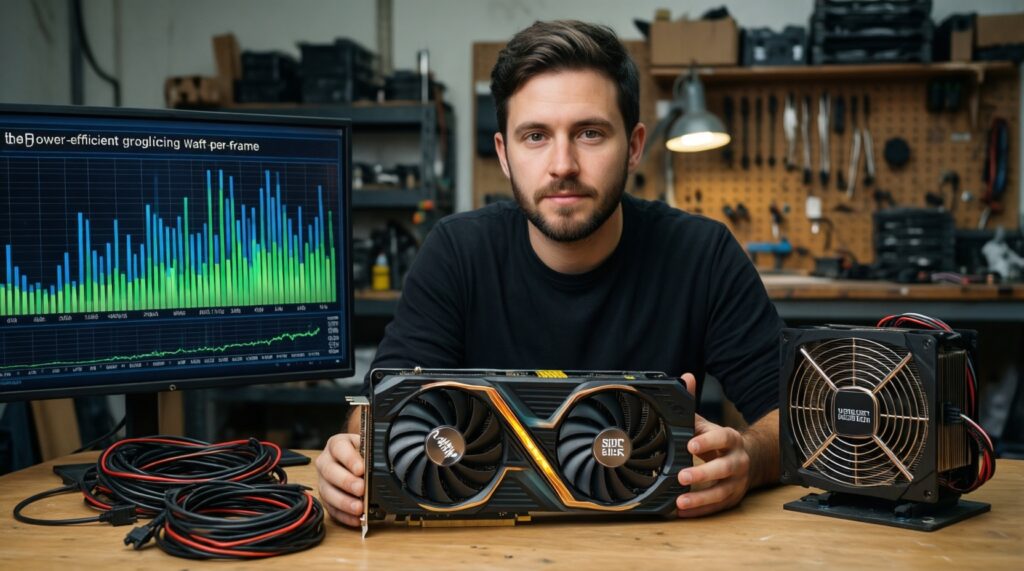
Efficiency is where generations often diverge the most. If you're asking การ์ดจอประหยัดไฟ รุ่นไหนดี, compare on watt-per-FPS (lower is better) and then sanity-check the required PSU, connector type, and cooler acoustics for your case.
| Option (new vs old archetype) | Who it fits | Pros | Cons | When to choose |
|---|---|---|---|---|
| New-gen efficient midrange (60/70-class) | Most 1080p-1440p gamers; small/quiet builds | Strong efficiency; typically cooler/quieter; modern media features | Can be price-inflated on release; some models limited by VRAM in newest titles | If electricity/heat/noise matter and you want a "balanced" upgrade without PSU changes |
| New-gen upper midrange (70/80-class) | 1440p high refresh; mixed competitive + AAA | Better 1% lows; more headroom for RT/upscaling; longer useful life | Higher upfront cost; may require stronger PSU and case airflow | If your monitor is 1440p 144Hz+ and you want consistent highs rather than "average FPS" |
| Previous-gen high-end used (80/90-class) | Buyers who can inspect/test used hardware | High raster FPS per baht on the right deal; wide availability | Higher power draw; more heat; unknown mining/aging risk; may need new PSU | If street price is deeply discounted and you can verify temps, noise, and stability |
| Previous-gen midrange used (60/70-class) | Budget upgrades from iGPU/very old GPUs | Lowest entry cost; often "good enough" for 1080p | Less feature longevity; weaker in heavy new titles; resale value may drop faster | If you just need a safe 1080p uplift and accept dialing down settings |
| Entry-level new (50/60-class) vs older midrange | Small PSUs, compact PCs, light gaming | Low power and simple installs; warranty | May lose to older midrange in pure FPS/baht; VRAM limits can appear sooner | If you must stay within strict power/size limits and want warranty coverage |
| Hold/optimize current GPU (undervolt + settings tuning) | Anyone not clearly GPU-bound or waiting for better pricing | Zero capex; can cut heat/noise; often recovers stability | No new features; limited upside if you're truly GPU-limited | If your bottleneck is CPU/RAM or prices are unfavorable in your area right now |
Price Anatomy: MSRP, Street Price and Total Cost of Ownership
In Thailand, the answer to ราคาการ์ดจอล่าสุด 2026 is always "check street price today," then translate it into total cost. Use scenarios like these to avoid false bargains:
- If the GPU deal forces a PSU upgrade (wattage, connectors, quality), then add that cost before judging "value."
- If a used high-end card is cheap but runs hot/noisy in your case, then include the cost of better airflow/cooler maintenance (paste, pads) or pick a more efficient tier.
- If you play mostly competitive titles at 1080p and are CPU-limited, then prioritize CPU/platform first; a bigger GPU may not increase FPS meaningfully.
- If your target is 1440p/4K AAA, then price the GPU together with VRAM needs and your preferred quality settings; "cheap" cards can force settings cuts that defeat your goal.
- If a new card's MSRP looks fine but street pricing is inflated, then compare against discounted previous-gen and used options using the same cost-per-FPS method below.
Value Metrics: Cost-per-FPS and Practical ROI
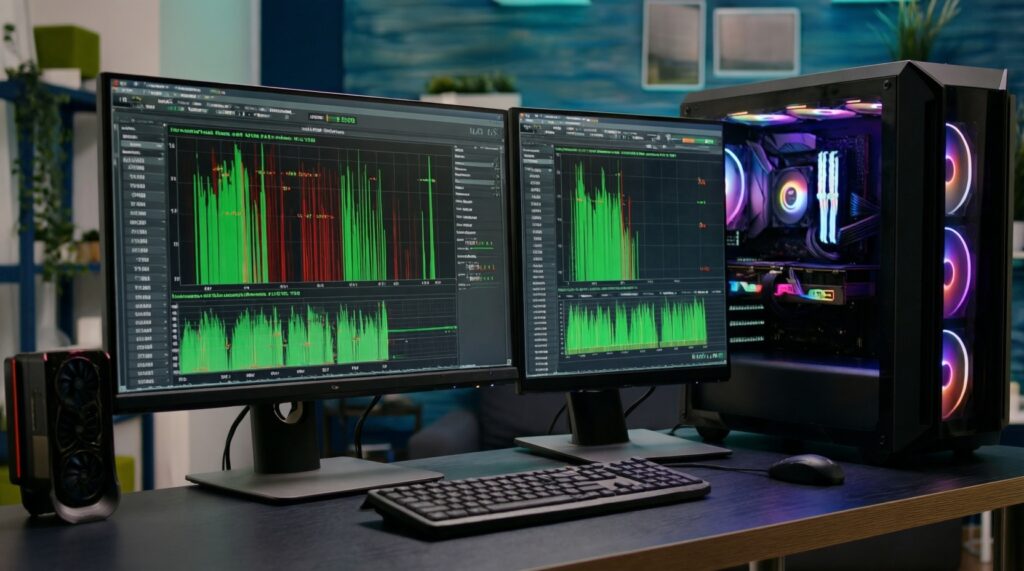
To answer การ์ดจอรุ่นไหนดีคุ้มสุด without guessing, compute value from your own benchmark pass (or a consistent dataset you trust) at your settings.
- Pick your target: e.g., 1440p High, upscaling off (or the same mode for all cards).
- Measure or collect FPS: record average FPS and 1% lows for each candidate.
- Normalize FPS: choose your current GPU as baseline = 100, then set others as an index (e.g., 135 means +35%).
- Compute cost-per-FPS:
Cost-per-FPS = Street Price (THB) / Average FPS(or use your normalized index consistently). - Compute efficiency:
Watts-per-FPS = Typical Gaming Power (W) / Average FPS. - Estimate payback (only if you have your own power price):
Payback Time = (Price Difference) / (Annual Electricity Savings). If you don't know your rate, compare only watts-per-FPS and treat "savings" as directional. - Apply constraints: PSU connectors, case length, and VRAM minimum; discard options that break constraints even if metrics look good.
Decision Tree for Buyers: Choose by Playstyle and Budget
Use this text decision tree to match your profile to a sensible "shortlist" before you obsess over a single model. It's designed for people searching การ์ดจอเล่นเกม fps สูง ราคาไม่แรง and trying to avoid overspending.
- Start: What is your main resolution?
- 1080p → Are you CPU-limited (GPU usage often below ~90% in matches)?
- Yes → prioritize CPU/platform; consider "Hold/optimize" GPU for now.
- No → choose "New-gen efficient midrange" or "Previous-gen midrange used" based on street price and warranty needs.
- 1440p → Do you target 120-165Hz in modern AAA?
- Yes → shortlist "New-gen upper midrange"; consider used previous-gen high-end only if PSU/thermals are comfortable.
- No → shortlist "New-gen efficient midrange" with sufficient VRAM for your game list.
- 4K → Are you okay with upscaling/frame-gen features?
- Yes → shortlist "New-gen upper midrange" and above; focus on 1% lows and VRAM behavior.
- No → expect higher tiers and higher total system cost; confirm PSU and case airflow first.
- 1080p → Are you CPU-limited (GPU usage often below ~90% in matches)?
Common buying mistakes that inflate cost or reduce real FPS gains:
- Comparing FPS from different games/scenes/presets, then calling it a "generation win."
- Ignoring 1% lows; a higher average can still feel worse.
- Buying an older high-end card without budgeting for PSU, heat, and noise.
- Assuming "newer always faster" or "older flagship always better"; tiers overlap across generations.
- Overpaying for VRAM you'll never use at your resolution, or underbuying VRAM and being forced into texture cuts.
- Not checking case clearance and cooler thickness (3-4 slot cards can create fit/airflow issues).
- Optimizing for MSRP instead of Thailand street price and promotions.
- Upgrading GPU when the real limit is CPU/RAM, especially at 1080p eSports settings.
Upgrade Strategy: When Holding Beats Upgrading
- If your GPU usage is inconsistent (often below full load) → don't upgrade yet; fix CPU/RAM/background load first.
- If you can't add PSU/cooling budget → prefer a new efficient midrange over a used high-end.
- If you found a verified used deal (stable temps, clean history, realistic power needs) → previous-gen high-end can be a strong "FPS per baht" play.
- If your games are trending heavier (new AAA) → prioritize stability (1% lows) and VRAM behavior over peak averages.
Best fit tends to be a new-gen efficient midrange for balanced 1080p-1440p gaming with lower heat and simpler total cost, while a discounted used previous-gen high-end can suit FPS-focused buyers who can validate condition and budget for power/thermals. If you're CPU-limited or pricing is inflated, holding and optimizing often delivers the cleanest value until street prices improve.
Buyer Doubts Resolved: Short Clarifications
Is a newer generation always better for FPS?
No. Tier overlap is real: an older high-end can beat a newer midrange in raw raster FPS, while the newer card may still win in efficiency and features.
Should I trust MSRP when comparing value in Thailand?
Use street price, not MSRP. Value decisions should be based on what you can actually buy today, including bundles and retailer promos.
Do I need to upgrade my PSU for an older high-end used card?
Often, yes-especially if the card has higher peak draw or different connectors. Treat PSU compatibility as a hard constraint before comparing cost-per-FPS.
What matters more: average FPS or 1% lows?
For perceived smoothness, 1% lows matter more. A card with slightly lower average FPS but higher 1% lows can feel better in real play.
How can I compare cards fairly if benchmarks differ?
Normalize results: same game build, same scene, same settings, and same upscaling mode. If you can't, use an FPS index from one consistent source rather than mixing charts.
When does "hold and optimize" make the most sense?
When your GPU isn't the bottleneck, or when upgrading triggers extra spend (PSU/case/cooling) that destroys value. Undervolting and settings tuning can reduce heat and stabilize frame-times.